
Extreme Ownership on the Job Site: 9 Leadership Principles Every Rehabber and Builder Should Run By
May 26, 2026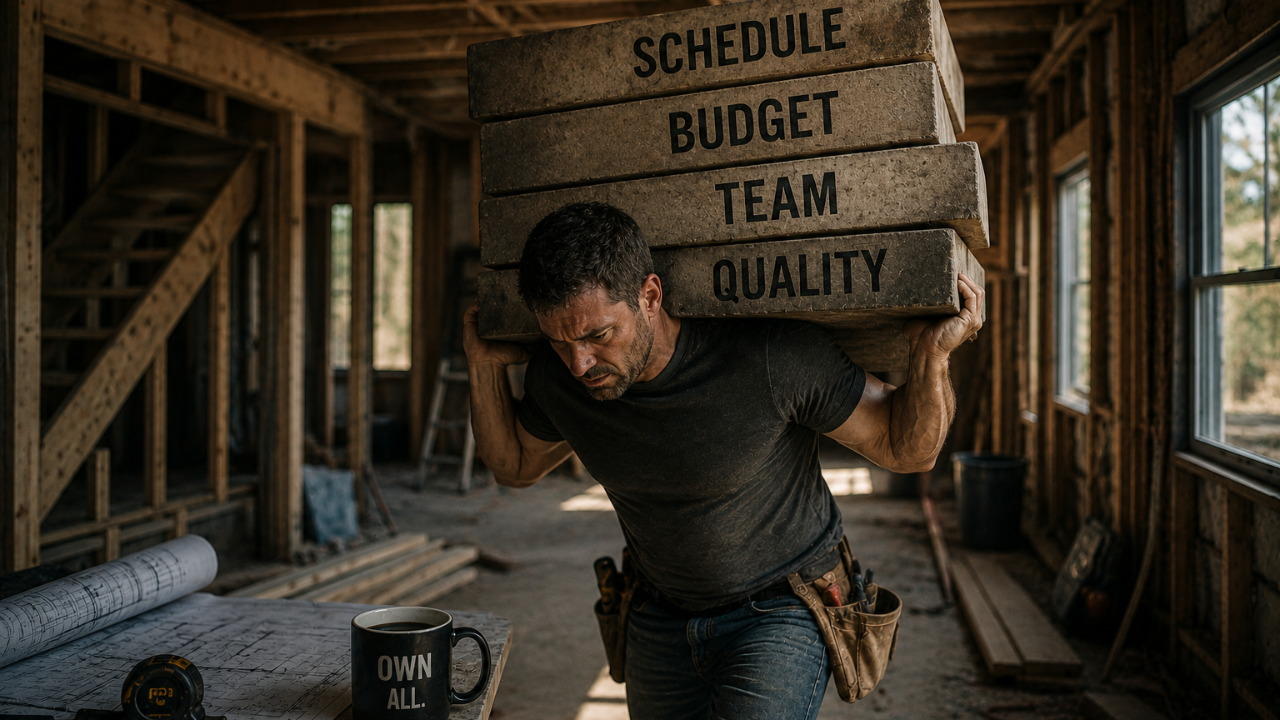
Inside our TRP community, we have something called the TRP Book Club. Every month, we read a book together.
This past month, we read Extreme Ownership by Jocko Willink and Leif Babin.
I’ve now read this book a couple of times. And at this point in my life, I’ll say it plainly:
It’s the best book on leadership I’ve ever read.
The principles in it are ones I hold near and dear. I use them every day, on every job, with every team.
The book lays out 12 leadership principles. All of them apply to what we do.
But for this post, I want to zero in on the nine that hit hardest for rehabbers, builders, and project managers.
Let’s get into it.
Extreme Ownership
If you take one thing from this entire post - let it be this one.
We take 100% ownership of every single thing that happens on our projects.
Contractor messed up the framing? That’s on us. We hired him and didn’t vet him well enough.
Materials didn’t show up on time? That’s on us. We should’ve ordered earlier and communicated better.
Budget blew up? Schedule slipped? Inspector failed the rough-in? On us.
Until you take extreme ownership of every outcome, nothing changes. Nothing gets better.
The moment you own it all, you stop looking outward and start fixing your systems, your hiring, your communication. That’s where the real growth happens.
No Bad Teams, Only Bad Leaders
I come from a sports background, and I’ve seen this play out a hundred times.
Same roster, different coach. Suddenly the team is winning. Or losing. Culture flips. Performance flips.
It’s the same in business. And it’s especially true in rehabbing and building.
If your team isn’t performing, the answer isn’t to point fingers. The answer is to look in the mirror.
This one ties right back to extreme ownership. The performance of your team is your responsibility - always.
Check the Ego
Construction is full of ego. It’s one of the biggest reasons companies in this industry fail.
People walk around acting like they know everything. The reality is, nobody knows everything about construction.
Not the seasoned GC. Not the architect. Not me. Not you.
Codes change. Materials change. Methods change. Every single person in this business is wrong at some point.
The operators who win long-term are the ones with the humility to admit when they don’t know something - and to lean on others when they need to.
Ego will cost you more money than any bad sub ever will.
Cover and Move
The best teams I’ve been part of cover and move naturally. Nobody has to teach it.
Someone’s out on vacation, and the rest of the team picks up the slack. The site needs cleaning and nobody’s around - so the team handles it themselves.
It doesn’t mean you’re constantly finishing everyone else’s job. The point is that you have your team’s back, and they have yours.
When that mentality spreads across an organization, people stop protecting their lane and start moving the project forward together.
That’s a team. Anything less is just a group of people collecting paychecks.
Simple
I’ve written entire blogs about this one because I believe it so deeply.
Find every possible way to make this incredibly complicated business as simple as possible.
Where people go wrong is they overcomplicate something that’s already complicated enough on its own.
Elaborate spreadsheets. Five different software platforms. 40-page SOPs nobody reads.
That’s when balls get dropped and scopes get unchecked. The operator overcomplicated what could’ve been simplified.
Simplify your systems. Simplify your tools. Simplify your job.
Prioritize and Execute
In this business, the to-do list is never empty. Ever.
Permits. Materials. Inspections. Subs. Punch lists. Three different jobs all needing something from you right now.
What happens to most operators? They get overwhelmed. They react to whatever fire is loudest, and the important work never gets done.
You need the focus to take that long list, identify the one or two things that matter most, and attack those first.
Tunnel vision on the priority. Knock it out. Move to the next one.
Plan
There’s an old quote, often attributed to Lincoln: “Give me six hours to chop down a tree, and I will spend the first four sharpening the axe.”
That’s our business in a sentence.
Everything we do - our budget, our scope, our schedule, our permits, our profit - starts with the plan.
This is where most operators short themselves. They skip the deep planning because it doesn’t feel like progress.
But planning is the progress. The plan is what protects the project.
You can never plan too much. Sharpen the axe.
Decisiveness Amid Uncertainty
How many times as rehabbers or builders are we faced with a hard decision - and it paralyzes us?
Stick with the layout or open up the kitchen? Eat the cost overrun or push back on the sub? Fire the GC now or give him one more shot?
In this business, you will rarely have all the information you want. You have to make decisions with incomplete data - constantly. That’s the job.
Use your gut. Use your experience. Lean on your network.
But at some point, you have to make the call and move forward.
The paralysis is what kills you. Decide. Commit. Adjust if you have to. Keep moving.
Discipline Equals Freedom
This one might be my favorite. And it’s the one most operators get backwards.
A lot of people get into real estate thinking it’s going to give them freedom. They want to be free from discipline.
Here’s the trap: without structure, this business will own you. You’ll be reacting to every text, every fire, with no rhythm and no peace.
That’s not freedom. That’s chaos with a real estate license.
Real freedom comes from the opposite. From a weekly rhythm. From daily routines. From checklists, SOPs, and systems that hold the operation together whether you’re on-site or not.
That’s when the business gets fun. That’s when it gets profitable. That’s when you actually get your time back.
Discipline isn’t the opposite of freedom. It’s the source of it.
Final Word
These are nine of the twelve principles from Extreme Ownership. Every single one maps directly onto what we do.
If you haven’t read the book, read it. If you have, read it again.
Then start running your business by it.
Inside TRP, this is how we lead. With ownership. With humility. With simplicity. With discipline.
The principles work. You just have to use them.