
How to Actually Stay On Schedule (Most Rehabbers Don’t)
May 18, 2026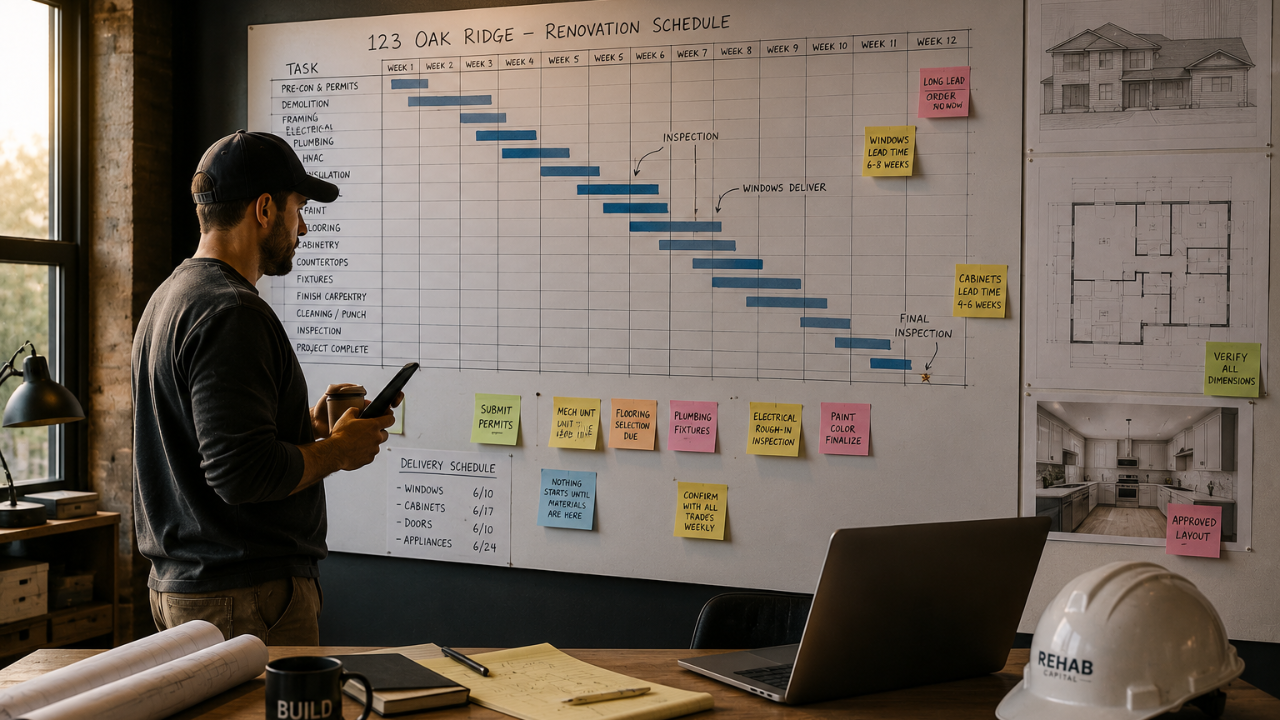
Scheduling looks easy on paper. You map out the trades, line up the dates, and on day one of the project, you feel dialed in.
Then week two hits.
A trade pushes a day. Materials show up late. An inspection gets bumped. The schedule you were so proud of is now a Frankenstein of crossed-out dates and frantic texts.
Here’s the truth: understanding the schedule is easy. Abiding by it is where most operators fall apart.
And when we fall behind, the natural reaction is to point fingers. The contractor flaked. The supplier dropped the ball. The inspector took forever.
But the schedule is yours. Every delay traces back to a decision you made or didn’t make.
The cost of a sloppy schedule isn’t just a late finish. It’s longer holding costs, slower cash flow, rushed work that creates rework, and the kind of stress that bleeds into every other deal on your plate.
So let’s get tactical. Here are the six habits that have made the biggest difference in how we run projects.
1. Use a Gantt Chart, Not a Spreadsheet
I get why people default to spreadsheets. Familiar, free, organized. I’ve used them too.
But a construction schedule isn’t static - it’s alive. It changes nearly every day.
Spreadsheets don’t flex. Every change means rebuilding the schedule by hand, and after a few of those, most people stop updating it. Now your schedule lives in your head instead of on a screen. That’s where projects start to drift.
A Gantt chart with proper dependencies solves this. You see the sequence visually. You drag and drop a task and everything downstream adjusts.
You don’t need a spreadsheet - you need a tool that moves with the job.
2. Schedule Everything, Not Just Labor
When most people hear “schedule,” they think trades. Framers Monday, electricians Wednesday, drywall the following week.
But the schedule is so much more than labor.
Inspections need to be on the schedule. Material deliveries need to be on the schedule. Permitting and pre-construction need to be on the schedule.
Here’s why this matters. Your framer can finish exactly on time, but if you didn’t book the framing inspection three days out, you’re sitting on a finished frame waiting on the inspector. The labor was on schedule. The project wasn’t.
Same with materials. Crew lined up, trade ready - but if the windows aren’t on site, nobody’s swinging a hammer.
Putting deliveries, inspections, and pre-con tasks on the Gantt chart is what turns a labor schedule into a real project schedule.
3. Document Long Lead Times Early
The fastest way to kill a project is to sit around waiting on materials. The most common reason it happens is that nobody flagged the lead time at the start.
Windows. Doors. Specialty siding. Custom cabinetry. Certain tile and flooring orders.
These items can have lead times of four, six, eight weeks or more. Miss the order date and you’ll find out the hard way when your install date arrives and the material doesn’t.
At the start of every project, walk the scope and flag every material with a meaningful lead time. Document the order date and the expected delivery date. Ideally, both live as items on your Gantt chart — the same way a trade does.
The longest poles in the tent should be visible from day one, not discovered in week six.
4. Identify At-Risk Items and Build In Buffer Days
Every project has tasks more likely to slip than others. Weather-dependent work. Scopes more complicated than they first appeared. Trades with tight availability. Items tied to long lead time materials.
Walk through the schedule and flag the at-risk items. Give them extra attention. Build contingency around them so a slip doesn’t cascade.
Beyond that, put buffer days between major trade handoffs. Drywall finishes Friday - don’t book paint to start Monday. Give it a day. Maybe two.
I know what that looks like at first glance. A wasted day. That’s the wrong way to look at it.
A buffer day isn’t wasted. It’s a regroup day. The day you walk the site, catch punch items the previous trade missed, confirm the next crew has what they need, and verify materials are staged.
Skip the buffer and you’ll lose days because the next trade shows up to a site that wasn’t ready.
One day of breathing room saves you three days of scrambling.
5. Communicate With a Rhythm
A schedule on a screen means nothing if your contractors and vendors aren’t in sync with it.
The way you communicate has to follow a rhythm:
- 3-4 weeks out: Give them the approximate week they should expect to start.
- 2 weeks out: Narrow it to a 2-3 day window.
- 1 week out: Lock in a concrete start date.
- 1-2 days before: Confirm they’re still on.
That last confirmation matters more than people realize. Don’t just ask “are you starting tomorrow?” Ask two things: are you starting tomorrow, and what time and how many guys?
The second question is the tell. A contractor who’s actually showing up can answer it without hesitation. A guy giving you a soft “yeah I’ll be there” but can’t tell you who’s coming - that’s a guy who isn’t coming.
You’d rather know today than find out at 9am tomorrow when nobody’s on site.
This rhythm applies to material deliveries too. Same cadence keeps everything moving in lockstep.
6. Daily Review With a Two-to-Three Week Focus
The schedule isn’t something you set and check on Mondays. It’s something you live with daily.
Review it every single day. First thing in the morning, or at the end of the day when you’re planning tomorrow. Done consistently, it takes a few minutes.
But the daily review isn’t just about tomorrow. You should always have a two-to-three week forward focus.
Looking out that far is how you catch problems before they become problems. The material that needs to be ordered now to land on time. The inspection that needs to be booked. The trade you need to start narrowing the window with.
And as you review, ask a sharper question than “is this on schedule?” Ask: what has to be true for this task to start on time?
Materials on site? Previous trade actually finished - not just almost finished? Inspection passed? Permit in hand?
That’s the question that catches the silent killers. Catch the gap two weeks out and you have time to fix it. Catch it the morning of and you’re already behind.
Final Word
Scheduling is one of the highest-leverage skills you can build as an operator. Not because the schedule itself is glamorous, but because everything that matters in this business is downstream of it.
Your margins. Your cash flow. Your reputation. Your stress level.
A project that finishes two weeks late isn’t just two weeks of extra holding costs. It’s two weeks of capital you can’t redeploy. It’s a contractor relationship under strain. It’s the next deal you can’t take on because this one’s still tying up your bandwidth.
Tight schedules protect your profit, your team, and your ability to scale.
The operators who win aren’t the ones with the most deals or the biggest crews. They’re the ones who do the boring work of staying on top of the schedule - every day, every project, without exception.
That’s the work. And it’s worth doing.